Most keyword research advice was not written for B2B service companies.
It was written for publishers, affiliate sites, and broad-content businesses chasing traffic at scale. That is why so much of it feels disconnected from how service websites actually grow. It talks about volume before intent, lists before structure, and “low competition keywords” before commercial fit.
That logic breaks fast in B2B.
A service website does not need thousands of random keywords. It needs the right search opportunities, mapped to the right pages, with a clear relationship between education, trust, and conversion. Google’s own guidance points in that same direction: content should serve a real audience, reflect a clear site focus, and leave readers feeling they learned enough to achieve their goal, rather than existing mainly to attract search visits.
So the real question is not “How do we find more keywords?”
It is:
How do we build a keyword research process that helps a B2B service website capture the right demand without creating content waste, keyword overlap, or weak commercial relevance?
That is the goal of this guide.
- What keyword research actually means for a B2B service website
- Why B2B keyword research is different
- The real purpose of keyword research
- The keyword research process for B2B service websites
- Step 1: Start with service reality, not keyword tools
- Step 2: Build around problem language, not just industry labels
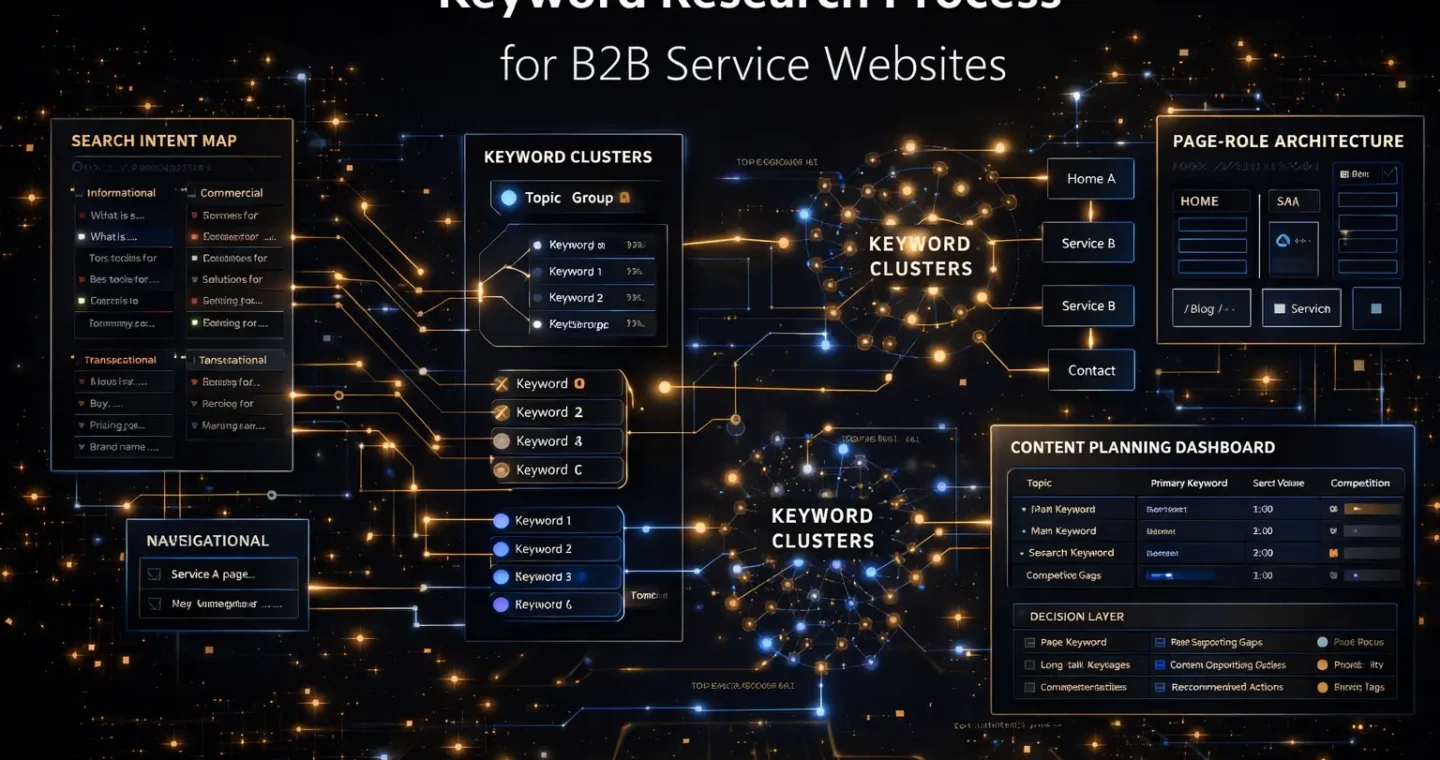
- Step 3: Split keywords by search intent before you judge them
- Step 4: Group keywords into themes, not isolated rows
- Step 5: Map keywords to page roles
- Step 6: Evaluate keywords by business value, not just search volume
- Step 7: Look for SERP shape, not just keyword metrics
- Step 8: Build a keyword model that prevents overlap
- Step 9: Use internal linking as part of keyword strategy
- Step 10: Revisit keywords as the site matures
- What makes a keyword worth targeting
- Common keyword research mistakes on B2B service websites
- What a strong B2B keyword research process produces
- The real advantage of doing this well
- FAQ
- What is the best keyword research process for a B2B service website?
- How is B2B keyword research different from general SEO keyword research?
- Should B2B service websites focus on high-volume keywords?
- How do you avoid keyword cannibalization in B2B SEO?
- What role does search intent play in keyword research?
What keyword research actually means for a B2B service website
Keyword research is not just the act of collecting search terms.
For a B2B service website, it is the process of identifying:
- what your market is searching for
- how those searches reflect stages of buying intent
- which pages should own which themes
- how informational content should support commercial pages
- where your site can realistically build authority
That is a more useful definition because it treats keywords as signals, not trophies.
A B2B keyword list is only valuable if it helps answer five practical questions:
- What does the audience actually care about?
- What problems do they search before they buy?
- What language do they use?
- Which searches deserve service pages versus content pages?
- How should the site be structured so pages support each other instead of competing?
That is what turns research into strategy.
Why B2B keyword research is different
B2B search behavior is usually narrower, slower, and more layered than B2C.
A B2B buyer often searches across multiple stages:
- early education
- problem definition
- solution exploration
- internal evaluation
- vendor comparison
- service validation
That means keyword research for a B2B service website is not mainly about chasing the biggest number.
It is about understanding commercial pathways.
For example, a search like:
- “what is technical SEO”
does not carry the same intent as:
- “technical SEO services”
And neither of those is the same as:
- “technical SEO audit checklist”
All three matter. But they do not belong to the same page or serve the same role.
This is one of the biggest reasons service websites underperform. They blur page purpose. Google’s guidance on helpful content and SEO basics strongly supports clarity here: pages should be useful, focused, easy to understand, and organized so both users and search engines can understand what the page is about.
The real purpose of keyword research
The best keyword research process does three things at once.
It reveals demand
You see what people are actually asking, comparing, and trying to solve.
It reveals intent
You understand whether the search belongs to:
- a service page
- a pillar page
- a supporting article
- a comparison page
- a use-case page
It reveals structure
You decide how those opportunities should live on the website so they strengthen each other instead of splitting relevance.
That is why keyword research should happen before content planning, not after it.
The keyword research process for B2B service websites
Step 1: Start with service reality, not keyword tools
Before touching any tool, define the actual business scope.
List:
- your core services
- your sub-services
- your ideal buyer types
- the business problems you solve
- the language clients use on calls, proposals, and email threads
- the objections prospects usually have before buying
This step matters because it keeps the research anchored in revenue.
Google’s people-first content guidance asks whether your site has a primary purpose or focus and whether the content would still be useful if someone came directly to you rather than through search. That is exactly the right filter for B2B service sites.
If a topic does not connect to a real service, real audience, or real problem, it usually does not belong in the main keyword strategy.
Step 2: Build around problem language, not just industry labels
A lot of keyword research starts too close to the company’s internal vocabulary.
That creates blind spots.
Buyers do not always search the polished phrase on your services page. Often they search the problem beneath it.
For example, instead of only starting with:
- technical SEO services
you also look at:
- why pages are not indexed
- crawl issues on service websites
- canonical tag problems
- site migration SEO loss
This is where better keyword research starts to feel more like customer research.
The most valuable keyword sets usually come from four language buckets:
- service terms
- problem terms
- outcome terms
- evaluation terms
That mix helps you avoid building a site that only ranks for self-descriptions instead of buyer intent.
Step 3: Split keywords by search intent before you judge them
This is the step most people rush.
Do not judge a keyword only by difficulty or volume first.
Judge it by intent.
A practical B2B service framework usually includes:
Commercial intent
These are searches close to buying or vendor evaluation.
Examples:
- ai automation services
- technical SEO consultant
- SEO audit agency
These usually belong to service or landing pages.
Informational intent
These are searches where the user wants to understand a concept, framework, or process.
Examples:
- what is RAG
- what is SEO
- technical SEO playbook
These usually belong to pillar or guide content.
Problem-solving intent
These are highly useful because they sit between education and buying.
Examples:
- why pages are not indexing
- how to automate invoice approvals
- how to fix duplicate content issues
These often make strong cluster articles, checklists, or diagnostic pages.
Comparative or evaluative intent
These searches appear when buyers are assessing options or trying to make a decision.
Examples:
- RAG vs fine-tuning
- workflow automation vs AI agents
- SEO agency vs in-house team
These are often some of the highest-leverage content assets on a B2B site.
If you do not separate intent early, you end up mapping the wrong keyword to the wrong page type.
Step 4: Group keywords into themes, not isolated rows
A good keyword research process does not produce a pile of disconnected phrases.
It produces topic groups.
That matters because one page should usually own one primary topic, supported by a cluster of closely related terms and questions. Google’s documentation repeatedly emphasizes helping search engines understand the page, organizing content clearly, and creating substantial value rather than producing lots of pages on many topics in hopes that some perform well.
So instead of treating these as separate unrelated targets:
- technical seo playbook
- technical seo checklist
- technical seo guide
you decide whether they belong to:
- one strong pillar
- one pillar plus one support article
- different pages with clearly different intent
This is where strategy protects you from cannibalization.
Step 5: Map keywords to page roles
Once themes are grouped, each theme should be assigned a page role.
That role is what keeps the website coherent.
Common page roles on a B2B service site include:
Service pages
These target commercial demand.
Their job is to convert.
Pillar pages
These target broader informational themes connected to the service category.
Their job is to build authority and capture educational demand.
Cluster articles
These target narrower supporting topics, objections, sub-questions, or use cases.
Their job is to deepen coverage and strengthen the pillar or service ecosystem.
Comparison or decision pages
These help buyers make distinctions.
Their job is to reduce uncertainty.
This is the point where keyword research becomes site architecture.
And that matters because Google uses links to find pages and understand relevance, so a clearer site structure helps both users and search engines make sense of the relationship between topics.
Step 6: Evaluate keywords by business value, not just search volume
This is where many B2B sites go wrong.
A keyword with lower volume can be far more valuable than a broader query if it is:
- closer to commercial intent
- more tightly aligned with your service
- more likely to attract qualified visitors
- more realistic for your site to win
So instead of asking only:
- How many people search this?
ask:
- Is this the right audience?
- Does this connect to a real service?
- Does this support a trust-building journey?
- Can this page realistically become one of the better results on the topic?
- Would this still be worth publishing if search volume tools did not exist?
That last question is underrated.
It helps filter out keywords that look attractive in tools but weak in real business strategy.
Step 7: Look for SERP shape, not just keyword metrics
A keyword is not only a phrase. It is a search environment.
Before you finalize a target, look at what kind of pages already rank:
- service pages
- guides
- blog posts
- comparison pages
- forums
- tool pages
- documentation
- AI-generated overviews or summaries
This tells you what Google currently considers the likely fit for the query.
That matters because if the search results are dominated by educational explainers, trying to rank a hard-sell service page may be the wrong move. If the results are heavily commercial, a blog post may struggle to satisfy the intent.
Keyword research becomes much stronger when you study the query ecosystem, not just the phrase itself.
Step 8: Build a keyword model that prevents overlap
This is where B2B content systems either become scalable or messy.
Each important keyword theme should have:
- one clear owner page
- related supporting terms
- a defined role in the funnel
- a relationship to nearby pages
Without this, the site slowly creates duplicate intent:
- two pages targeting the same concept
- blog posts competing with service pages
- pillars overlapping with clusters
- multiple articles answering the same question in slightly different wording
That is not just inefficient. It also weakens your internal relevance model.
A keyword process should reduce future confusion, not create it.
Step 9: Use internal linking as part of keyword strategy
Keyword research does not stop at content planning.
Once topics are mapped, internal linking helps reinforce which pages matter and how they relate.
Google’s link guidance is clear: crawlable links and descriptive anchor text help Google understand the page being linked to.
For B2B service websites, that means:
- pillar pages should support service pages naturally
- cluster content should reinforce the broader topic
- anchor text should describe the destination clearly
- important commercial pages should not be left isolated
This is how keyword research starts influencing authority flow, not just article topics.
Step 10: Revisit keywords as the site matures
A young site and a mature site should not run the same keyword strategy forever.
As authority grows, the website can move into:
- broader pillar topics
- harder comparison terms
- more competitive service modifiers
- deeper adjacent subtopics
Google’s SEO Starter Guide also recommends updating content when needed and deleting or improving content that is no longer relevant or useful.
That means keyword research should be ongoing, not a one-time brainstorm.
A strong process keeps asking:
- Which pages are already gaining traction?
- Where are we under-covered?
- Which topics deserve expansion?
- Which pages are too close together?
- Which searches are converting, not just attracting visits?
What makes a keyword worth targeting
A keyword is worth targeting when it sits at the intersection of:
- audience relevance
- business relevance
- realistic competitiveness
- page-role clarity
- content opportunity
That is the better model.
Not:
- big volume = good keyword
But:
- strong fit + strong intent + strong page logic = good keyword
This is especially true for B2B service sites, where one strong page can be worth more than dozens of low-intent articles.
Common keyword research mistakes on B2B service websites
The most common mistakes are predictable.
They include:
- choosing topics based on tool volume alone
- targeting broad terms with no page-role clarity
- writing informational content that competes with service pages
- publishing multiple pages around the same intent
- ignoring problem-language keywords
- chasing traffic outside the company’s service focus
- building content around phrases the audience does not actually use
Google’s helpful content guidance explicitly warns against producing lots of content on many different topics in hopes that some of it performs well. That warning fits bad keyword research almost perfectly.
What a strong B2B keyword research process produces
A strong process should give you more than a spreadsheet.
It should give you:
- a clearer content architecture
- a stronger separation between commercial and informational intent
- better topic ownership
- less cannibalization risk
- more useful internal linking opportunities
- a roadmap for authority building around your core services
That is what makes keyword research strategic.
It stops being an SEO task and starts becoming a visibility model for the whole site.
The real advantage of doing this well
The best B2B service websites rarely win because they found a secret keyword.
They win because they understand their market more clearly than competitors do.
They know what their buyers search, how those searches evolve, which pages deserve ownership of which topics, and how content should support trust before conversion.
That is why keyword research is more than a content planning exercise.
It is the process of translating market demand into site structure.
Do that well, and the website becomes easier to scale, easier to navigate, and easier to trust.
Do it poorly, and even good writing ends up scattered across the wrong pages.
If your team wants a keyword strategy built around service relevance, topical clarity, and long-term content performance, our Content SEO services are designed to help build exactly that kind of system.
FAQ
What is the best keyword research process for a B2B service website?
The best process starts with real services, buyer problems, and search intent before moving into tools and metrics. It should group topics into themes, assign page roles, and connect keyword choices to business goals rather than traffic volume alone.
How is B2B keyword research different from general SEO keyword research?
B2B keyword research usually focuses more on commercial fit, problem-language, and longer buying journeys. The goal is often to attract qualified visitors and support service pages, not just publish content around broad high-volume topics.
Should B2B service websites focus on high-volume keywords?
Not always. A lower-volume keyword can be far more valuable if it reflects strong intent, aligns closely with a service, and supports a realistic page strategy. Business relevance often matters more than raw search volume.
How do you avoid keyword cannibalization in B2B SEO?
Avoid cannibalization by assigning one clear owner page to each important keyword theme, separating commercial and informational intent, and grouping closely related terms into structured topic clusters instead of scattered articles.
What role does search intent play in keyword research?
Search intent determines what kind of page should target a keyword. A service page, pillar article, comparison page, and cluster article all serve different intents, so the keyword research process should sort terms by purpose before content is created.