Most SEO conversations still start with keywords.
That makes sense. Keywords help search engines understand what a page might be relevant for. But modern search also tries to understand the real-world things behind pages: companies, people, products, organizations, and the relationships between them. Google’s Knowledge Graph is built around exactly that idea, describing real-world entities and the connections between them.
That is where entity SEO becomes useful.
Not as a trendy label.
Not as a secret ranking trick.
And definitely not as “just add schema and hope.”
A better way to think about it is this:
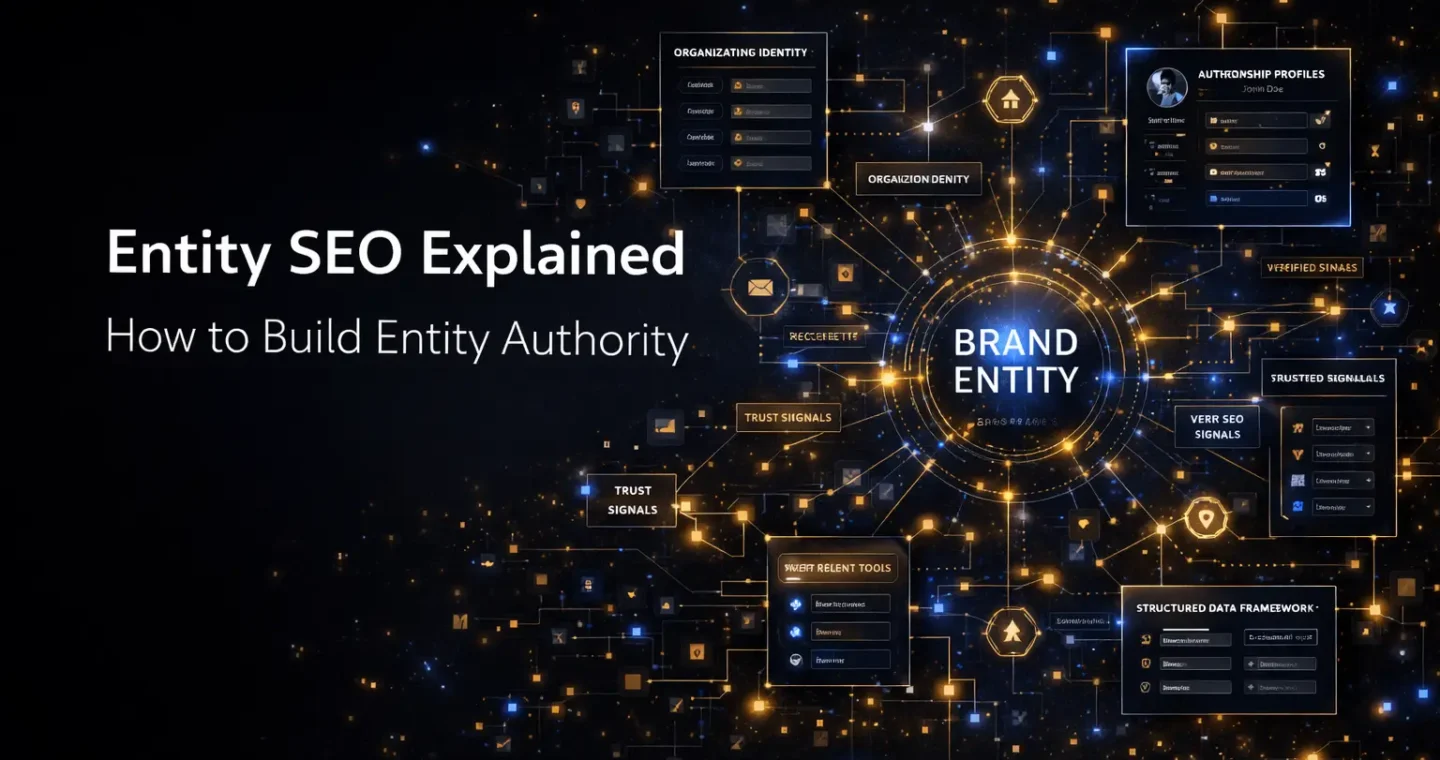
Entity SEO is the practice of making your brand easier for search systems to identify, understand, trust, and place in context.
For B2B websites, that matters more than many people realize. A service company can publish strong articles and optimize titles correctly, but if the site still feels vague at the brand level, search systems get a weaker picture of who is publishing the content, what the company is known for, and why it should be trusted on the subject.
That is the gap entity SEO helps close.
- What entity SEO actually means
- Why entity SEO matters beyond keywords
- What entity authority actually is
- The biggest mistake people make with entity SEO
- The foundations of entity authority
- Organizational clarity
- Site name consistency
- Clear authorship and expertise
- Topical consistency
- Structured identity signals
- How to build entity authority on a B2B website
- Make the homepage do real identity work
- Strengthen the About page
- Implement Organization markup properly
- Keep the naming system stable
- Build a body of work around core expertise
- Make people behind the content visible
- Entity SEO and AI search
- What entity SEO is not
- Why entity authority compounds over time
- FAQ
What entity SEO actually means
“Entity SEO” is not an official Google product term.
But the idea behind it is strongly supported by Google’s public documentation. Google documents entities through the Knowledge Graph, describes Organization markup as a way to help Google understand and disambiguate a business, supports site name markup to clarify site identity, and recommends strong authorship and people-first content signals so users and search systems can better understand who is behind a page.
So in plain language, entity SEO is about reducing ambiguity.
When search systems look at your site, they should not have to guess:
- who the company is
- what it does
- what topics it specializes in
- who writes its content
- whether the brand is consistent across the site
- how the content fits the company’s core purpose
The clearer those signals are, the stronger your entity foundation becomes.
Why entity SEO matters beyond keywords
Keywords explain relevance at the query level.
Entities explain relevance at the identity level.
That distinction is important.
A page may target “technical SEO services” or “AI integration architecture.” But search systems also try to understand whether the publisher is a real specialist in that area, whether the site has a clear focus, and whether the page belongs inside a coherent body of expertise. Google’s helpful content guidance asks whether a site has a primary purpose or focus and whether readers would leave with the impression that the content is well-trusted and comes from people who know the topic well.
That is why entity SEO matters so much for B2B brands.
B2B buyers do not only evaluate pages. They evaluate the company behind them.
Search systems increasingly do something similar.
What entity authority actually is
Entity authority is not just fame.
It is clarity plus trust plus consistency.
A company builds entity authority when search systems can more confidently answer:
- what this organization is
- what it is associated with
- which topics it covers deeply
- which pages define it
- which people represent it
- whether the site’s structure and content reinforce one believable identity
Google’s Organization markup guidance is especially useful here because it recommends including as many relevant properties as apply to help Google better understand the organization and disambiguate it from others. Google specifically points to properties like name, alternateName, address, telephone, url, and logo as useful signals.
So the first layer of authority is not hype.
It is disambiguation.
The biggest mistake people make with entity SEO
Most entity SEO articles collapse into one of two weak ideas.
The first is that entity SEO is just schema markup.
The second is that entity SEO is just getting mentioned around the web.
Both are incomplete.
Structured data helps search engines understand a page more explicitly, and Google says it can provide clear clues about page meaning. But Google also says structured data does not guarantee any particular search appearance, even when it is implemented correctly.
That means schema can reinforce entity understanding, but it cannot create authority out of thin air.
At the same time, external mentions can support recognition, but if the site itself is weak, inconsistent, or unclear, those mentions do not fix the underlying identity problem.
The stronger view is this:
Entity SEO is a system made of structure, consistency, clarity, authorship, and topical coherence.
The foundations of entity authority
A strong entity foundation usually comes from five core layers working together.
Organizational clarity
The site should make the company easy to understand.
That sounds simple, but many B2B sites still hide behind generic messaging. The homepage says something vague. The About page says almost nothing. Contact and organization details are thin. Search systems can still crawl the site, but the entity itself remains fuzzy.
Google’s Organization markup documentation recommends placing organization details on the homepage or another page that clearly describes the organization and adding as many relevant properties as apply. It explicitly frames this as a way to help Google understand administrative details and disambiguate the organization in search results.
A strong B2B site should make these things easy to understand:
- the company name
- what it does
- who it serves
- what category it belongs to
- how it should be distinguished from similar organizations
Site name consistency
Brand inconsistency weakens entity clarity.
Google’s site name documentation says Google Search supports one site name per site and provides structured data support to help Google understand it.
That matters because many sites casually vary their naming:
- full brand name in one place
- short brand name somewhere else
- different capitalization or alternate naming in metadata
- mismatched site name and organization name
A stronger entity signal keeps naming stable across:
- homepage
- title elements
- site name markup
- Organization markup
- logo usage
- About page language
Small inconsistencies may not break rankings, but they do make the brand feel less precise.
Clear authorship and expertise
Entity SEO is not only about the company entity. It also includes the people connected to the content.
Google’s article structured data documentation recommends including author information and specifically recommends author.name and author.url so Google can better understand authors across features. Google’s helpful content guidance also recommends making it easy for readers to know who created the content and why they should trust them.
That means a B2B site should not publish content that feels anonymous.
A stronger setup includes:
- a visible byline
- a real author or reviewer identity
- a bio or profile page where relevant
- a believable link between the author and the company’s expertise
This is one of the easiest ways to make content feel more legitimate.
Topical consistency
Search systems understand brands more clearly when the content has a center of gravity.
Google’s helpful content documentation warns against creating lots of content on many unrelated topics in hopes that some of it will perform well. It also asks whether the site has a main purpose or focus.
That guidance is extremely relevant to entity SEO.
A B2B brand that consistently publishes around:
- AI automation
- AI integration
- content SEO
- technical SEO
- workflow automation
- RAG
- search visibility
becomes easier to associate with those topics.
A site that publishes random, disconnected trend articles becomes harder to understand as a specialist entity.
This is why topical discipline matters. It strengthens the brand-level signal behind the pages.
Structured identity signals
Structured data is not the whole strategy, but it is an important reinforcement layer.
Google says structured data helps it understand the content of a page and can make pages eligible for richer appearances in search. For entity-related clarity, the most relevant Google-supported markup types often include Organization, Article, Breadcrumb, and site name-related signals.
For a B2B site, the most useful stack usually looks like this:
- Organization on the homepage or About page
- Article or BlogPosting on blog content
- Breadcrumb to reinforce site hierarchy
- clear author properties where relevant
- site name consistency in markup and visible branding
The key is alignment. The structured data should reinforce what the page visibly says, not contradict it.
How to build entity authority on a B2B website
This is where the concept becomes practical.
A strong entity SEO system makes the website tell one clear story from multiple angles.
Make the homepage do real identity work
A homepage should not only look polished.
It should explain:
- who the company is
- what it specializes in
- who it helps
- why it exists
- what topics define its expertise
That is not just conversion copy. It is entity clarification.
If the homepage reads like vague agency wallpaper, the brand stays harder to place.
Strengthen the About page
Many sites treat the About page like filler.
That is a missed opportunity.
For entity authority, the About page is often one of the most important brand-level pages because it helps tie together:
- company story
- expertise
- category
- leadership or team identity
- real-world presence
- trust signals
This page does not need to be dramatic. It needs to be unmistakable.
Implement Organization markup properly
Google’s guidance says organization markup can help Google better understand the organization and disambiguate it in search. It recommends focusing on details that are useful to users and that reflect real-world or online presence.
That means:
- use real, accurate organization data
- keep the markup aligned with visible content
- use the same
nameandalternateNameyou use across the brand - include
url,logo, and other relevant details
The point is not to “stuff schema.”
The point is to remove ambiguity.
Keep the naming system stable
The company name, site name, and visible brand treatment should feel unified.
Google’s site name support makes this more important, because one site can only support one site name in Search at the domain or subdomain level.
That means a B2B brand should choose clear naming conventions and stick to them across:
- header branding
- metadata
- homepage language
- schema markup
- author affiliations
- social profiles if referenced
This is one of those boring details that quietly improves trust.
Build a body of work around core expertise
Entity authority is reinforced when the site consistently covers a defined territory well.
This is where content strategy and entity strategy merge.
A good B2B content system does not publish disconnected pieces for random traffic. It builds a recognizable expertise footprint around the services and problems the business actually solves. Google’s helpful content guidance strongly supports this with its focus on primary purpose, audience usefulness, and substantial value.
In practice, that means:
- pillar pages for major service-adjacent themes
- cluster content around those pillars
- commercial pages that clearly define the offer
- internal links that reinforce topical relationships
That kind of structure strengthens both SEO and entity clarity.
Make people behind the content visible
This is one of the most underused entity signals on B2B sites.
Google explicitly recommends author information for articles and supports linking to a page that uniquely identifies the author.
So if the site publishes serious thought leadership, strategic articles, or expert explainers, the content should not feel like it came from nowhere.
Visible authorship helps both users and search systems understand the human layer behind the expertise.
Entity SEO and AI search
This topic matters even more now because AI-assisted search systems increasingly need to choose sources, not just rank pages.
A site that is easier to understand as an entity is easier to contextualize:
- what organization published this
- whether the topic fits the organization’s expertise
- how the page fits into the brand’s broader body of work
- whether the publisher looks coherent enough to trust
Google’s broader guidance around helpful content, clear identity, authorship, and site understanding all point in this direction, even if Google does not publish a document called “entity SEO.”
That makes entity work relevant not only for classic search, but for AI citation readiness too.
What entity SEO is not
It is not a shortcut around weak content.
It is not a schema-only tactic.
It is not guaranteed by getting a knowledge panel.
It is not about trying to “game the Knowledge Graph.”
And it is not separate from the rest of SEO.
Entity SEO is strongest when it works with:
- people-first content
- clear site architecture
- strong internal linking
- consistent branding
- credible authorship
- structured identity signals
- focused topical coverage
That is why it compounds.
It does not just help one page rank. It makes the whole site make more sense.
Why entity authority compounds over time
The real advantage of entity authority is that it lifts the context around everything else.
When your organization is easier to identify and trust:
- service pages feel more credible
- pillar content feels more grounded
- supporting articles feel like part of a specialist system
- authorship looks more believable
- the site feels less like a collection of isolated URLs
That is especially powerful in B2B, where trust and specialization matter so much.
Because at some point, good SEO is not only about which page says the right words.
It is also about which company deserves to own the topic.
That is where entity authority starts to matter in a much deeper way.
And if your team wants content and site structure that strengthen both topic ownership and brand-level trust, our Content SEO services are built exactly for that kind of growth.
FAQ
What is entity SEO?
Entity SEO is the practice of making a brand, organization, or person easier for search systems to identify, understand, and connect to relevant topics. It is based on how search engines work with real-world entities such as those described in Google’s Knowledge Graph.
Is entity SEO an official Google term?
No. “Entity SEO” is a practical SEO term, not an official Google product label. But the concept is grounded in Google’s public documentation about entities, organization disambiguation, site names, article authorship, and helpful content.
How do you build entity authority?
You build entity authority by making the organization clearer and more consistent across the site through strong homepage and About page positioning, Organization markup, stable site naming, clear authorship, focused topical coverage, and structured identity signals.
Does Organization schema improve entity SEO?
Organization schema can help Google better understand and disambiguate your organization in search results, but Google does not guarantee any specific search appearance just because markup is present. It works best as part of a broader trust and clarity system.
Why does entity SEO matter for B2B websites?
It matters because B2B buyers and search systems both rely on trust, specialization, and clarity. A stronger entity foundation makes your brand easier to associate with the topics and services you want to be known for.