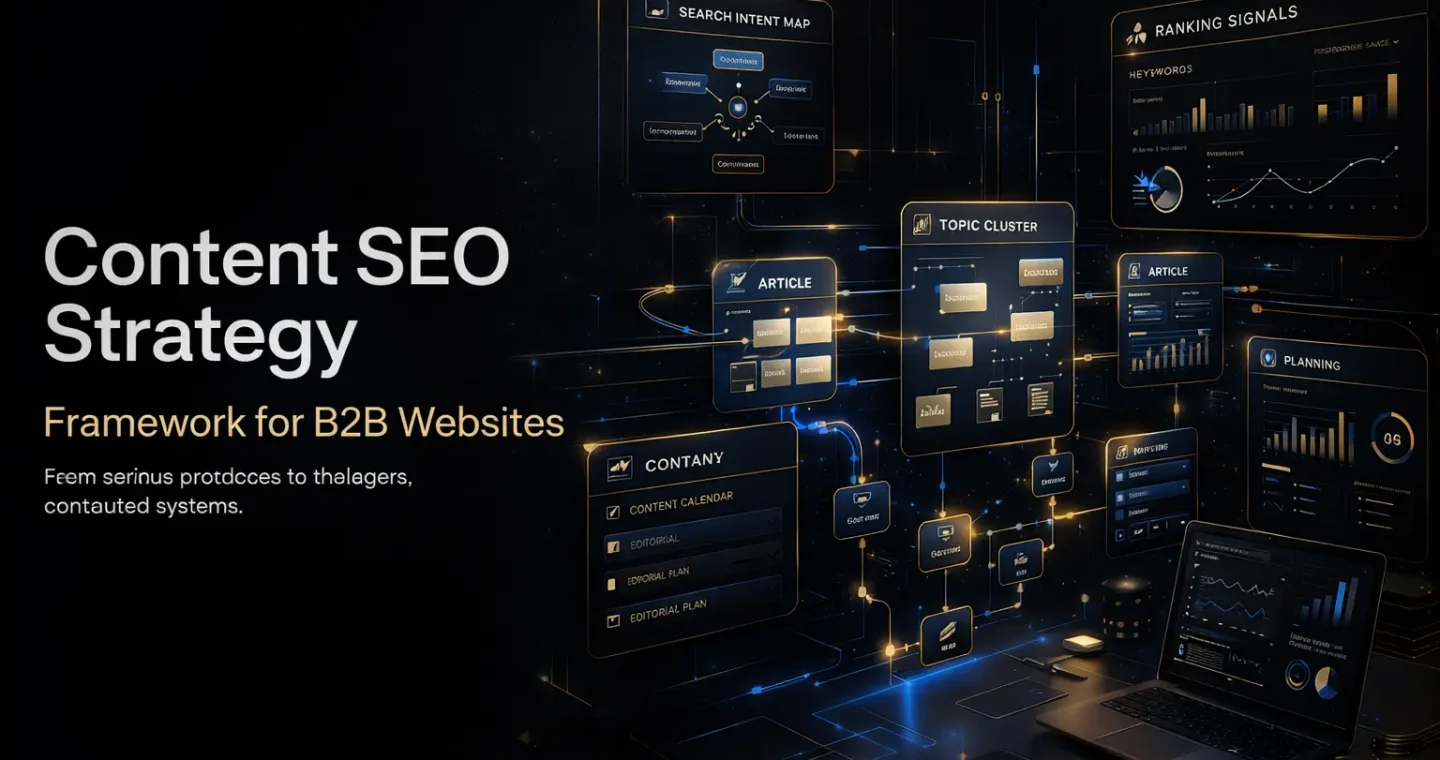
A content SEO strategy framework is the system behind how a B2B website plans, creates, structures, and improves content so it can rank, earn trust, and support real business goals.
That distinction matters.
A lot of companies publish content without a framework. They write random blog posts, target disconnected keywords, and hope traffic turns into leads. Usually, it does not. Google’s guidance is clear that helpful content should be created for people, not mainly to attract search visits, and that strong content should provide original value, real expertise, and a satisfying experience.
So for B2B websites, content SEO is not about publishing more. It is about building the right structure.
This guide explains what a content SEO strategy framework is, why B2B companies need one, and how to build a system that supports rankings, authority, and conversion at the same time.
- What a content SEO strategy framework actually means
- Why B2B websites need a real content framework
- The core parts of a content SEO strategy framework
- Audience clarity
- Search intent mapping
- Content type selection
- Keyword ownership
- Topical authority
- Internal linking logic
- What a strong B2B content SEO framework looks like
- How to build a content SEO strategy framework
- Common mistakes in B2B content SEO
- How to judge whether the framework is working
- Why this matters more now
- FAQ In Content SEO Strategy
What a content SEO strategy framework actually means
A content SEO strategy framework is a repeatable model for deciding:
- what content to create
- who it is for
- what search intent it targets
- where it belongs on the website
- how it supports business goals
- how it connects to revenue pages
In simple terms, it keeps content from becoming random.
Without a framework, content often becomes:
- too broad
- repetitive
- disconnected from services
- hard to scale
- difficult to trust
- weak in search performance
By contrast, a good framework gives every piece of content a job.
Some pages educate.
Some pages capture commercial intent.
Some pages build authority around a topic.
Some pages help move readers closer to a buying decision.
That approach aligns far better with Google’s people-first content guidance, which emphasizes usefulness, focus, originality, and clear audience value.
Why B2B websites need a real content framework
B2B content works differently from B2C content.
The buying cycle is longer. The stakes are higher. And the audience usually needs more clarity before taking action.
In B2B, people often search for:
- definitions
- frameworks
- comparisons
- implementation guides
- checklists
- service evaluation criteria
- ROI questions
That means content cannot just be “interesting.” It has to reduce uncertainty.
At the same time, Google recommends creating content that clearly helps the intended audience, demonstrates first-hand expertise or deep knowledge, and leaves readers feeling they learned enough to achieve their goal.
So a B2B content SEO framework should do three things well:
- capture relevant search demand
- build trust through expertise
- support the commercial pages that drive leads
The core parts of a content SEO strategy framework
Audience clarity
First, define who the content is for.
That sounds obvious. However, many websites skip it.
Google’s guidance asks whether you have an existing or intended audience that would find the content useful if they came directly to your site. That is an important filter.
For B2B websites, that audience may include:
- founders
- operations leaders
- marketing teams
- revenue leaders
- technical stakeholders
- procurement decision-makers
Each group searches differently. Therefore, content should reflect that.
Search intent mapping
Next, map content to intent.
Not every keyword deserves the same type of page.
A solid framework separates:
- informational intent
- commercial investigation intent
- transactional intent
- navigational intent
For example:
- “what is technical SEO” is informational
- “technical SEO services” is commercial
- “technical SEO checklist” is problem-solving
- a brand search is navigational
If you blur these intents together, the page becomes weaker.
Content type selection
Then choose the right format.
Different topics need different content types:
- pillar pages
- guides
- checklists
- comparisons
- use cases
- frameworks
- service pages
- FAQs
This is where strategy becomes practical.
Do not force every keyword into a blog post. Some topics need a service page. Others need a deep educational guide. Others work best as supporting content around a pillar.
Keyword ownership
A strong framework gives each page a clear primary keyword focus.
That helps avoid overlap and confusion.
Google’s SEO Starter Guide does not tell publishers to cram every keyword into one page. Instead, it emphasizes writing naturally, organizing content clearly, and helping search engines understand the page.
For B2B sites, keyword ownership matters because scattered targeting often leads to:
- cannibalization
- diluted authority
- weak page purpose
- inconsistent internal linking
Topical authority
A content framework should also organize content by themes, not just isolated keywords.
That means building a topic with layers.
For example, one strong pillar can be supported by:
- definitions
- playbooks
- comparisons
- FAQs
- implementation articles
- related strategic topics
This helps users understand the subject more fully. It also aligns with Google’s guidance around substantial, complete, and insightful coverage.
Internal linking logic
Content should not sit alone.
A framework needs internal links that:
- connect related ideas
- support service pages
- reinforce hierarchy
- guide users toward the next logical step
At the same time, those links should feel natural. They should help the reader, not interrupt them.
What a strong B2B content SEO framework looks like
A practical framework usually works in layers.
Layer 1: Commercial pages
These are the pages that convert.
They target service-level intent and explain:
- what you offer
- who it is for
- how it works
- why it matters
- what outcomes to expect
These pages should not be buried under blog content. They are core assets.
Layer 2: Pillar content
Pillar pages cover broad but important subjects in depth.
They help:
- capture broader informational demand
- establish authority
- connect readers to deeper content
- support adjacent commercial pages
For this topic, the article itself is a pillar.
Layer 3: Supporting cluster content
These are narrower articles that answer specific questions, solve sub-problems, or target longer-tail searches.
Examples might include:
- how to map search intent for B2B content
- how to build a B2B editorial SEO calendar
- content pruning for SEO
- topic clusters for service businesses
This content strengthens the overall content system instead of competing with it.
How to build a content SEO strategy framework
Start with business goals
First, tie content to outcomes.
Do not begin with, “What blog topics should we publish?”
Instead ask:
- What services matter most?
- What audience do we need to attract?
- What problems do they search before buying?
- What trust gaps need content support?
That is how content becomes strategic instead of decorative.
Build around real audience needs
Google’s people-first guidance repeatedly stresses audience usefulness, focus, and real value.
So before planning content, define:
- what the audience already knows
- what they still need to understand
- what objections they may have
- what terms they search
- what would make them trust the page
That gives your content more depth and better relevance.
Match page type to search behavior
Some searchers want a definition. Others want a framework. Others want a provider.
A strong framework respects that difference.
For example:
- early-stage searches need educational content
- mid-funnel searches need comparison or process content
- bottom-funnel searches need service pages
The page format should match the intent behind the search.
Create original value
This is one of the most important parts.
Google explicitly asks whether content provides original information, research, or analysis, and whether it adds substantial value beyond what already exists in search results.
So your framework should not encourage:
- light rewrites
- generic summaries
- mass-produced articles
- filler content made only to target keywords
Instead, it should push for:
- stronger interpretation
- clearer frameworks
- sharper positioning
- better examples
- more useful structure
Make content easy to read
This matters for both users and SEO.
Google’s Starter Guide recommends content that is easy to read, well organized, and broken into paragraphs and sections with headings that help users navigate.
So in practice:
- keep paragraphs short
- vary sentence openings
- use transition words naturally
- avoid bloated sections
- use headings with a clear purpose
- simplify language where possible
For B2B, clarity beats complexity almost every time.
Add trust signals
Google’s guidance on E-E-A-T says trust is the most important element, and it encourages clear sourcing, authorship, background information, and evidence of expertise.
For a B2B website, that means content should make it easier to trust the brand behind it.
That can include:
- a clear author or reviewer
- a strong About page
- service expertise
- original insight
- consistent topical focus
Common mistakes in B2B content SEO
A lot of content programs fail for predictable reasons.
They publish too broadly.
They target the wrong terms.
They ignore business intent.
They create content that sounds polished but says very little.
Other common issues include:
- writing for volume instead of relevance
- producing articles with no clear audience
- mixing several intents into one page
- publishing without internal links
- creating blog posts that do not support service pages
- repeating what everyone else already said
Google’s guidance specifically warns against creating lots of content on many topics just in hopes that some of it will perform well.
That warning fits B2B content strategy perfectly.
How to judge whether the framework is working
A content SEO strategy framework should improve more than rankings.
It should improve:
- topic coverage
- content clarity
- internal linking strength
- relevance to the right audience
- support for service pages
- trust and authority over time
The goal is not random traffic.
The goal is qualified visibility.
That means the right people find the right page at the right stage of the journey.
Why this matters more now
Content SEO is getting harder for one reason:
Publishing is easy. Useful publishing is rare.
That is why the websites that win tend to be the ones with stronger systems. They know what each page is supposed to do. They build around real demand. And they create content that feels intentional from the first click to the next step.
A content SEO strategy framework gives you that control.
Without it, content becomes noise.
With it, content becomes infrastructure.
And in B2B, that difference shows up not only in rankings, but in trust, conversion quality, and how clearly the market understands what your company actually does.
If your team wants content that supports both authority and pipeline, our Content SEO services are built to help make that system real.
FAQ In Content SEO Strategy
What is a content SEO strategy framework?
A content SEO strategy framework is a system for planning, structuring, and improving content so it targets the right search intent, supports business goals, and strengthens overall organic visibility.
Why do B2B websites need a content SEO framework?
B2B websites need a content SEO framework because buyers search in a more research-heavy way. A clear framework helps content match intent, build trust, and support service pages more effectively.
What should be included in a B2B content SEO strategy?
A B2B content SEO strategy should include audience targeting, search intent mapping, content type selection, keyword ownership, internal linking, and a clear connection between informational content and commercial pages.
How is content SEO different from content marketing?
Content marketing focuses more broadly on brand communication and audience engagement. Content SEO focuses on making content discoverable in search while still being useful, relevant, and structured for the user.
How do you know if a content SEO framework is working?
You can judge a content SEO framework by looking at whether content is attracting the right audience, supporting important pages, improving organic visibility, and building stronger topical authority over time.