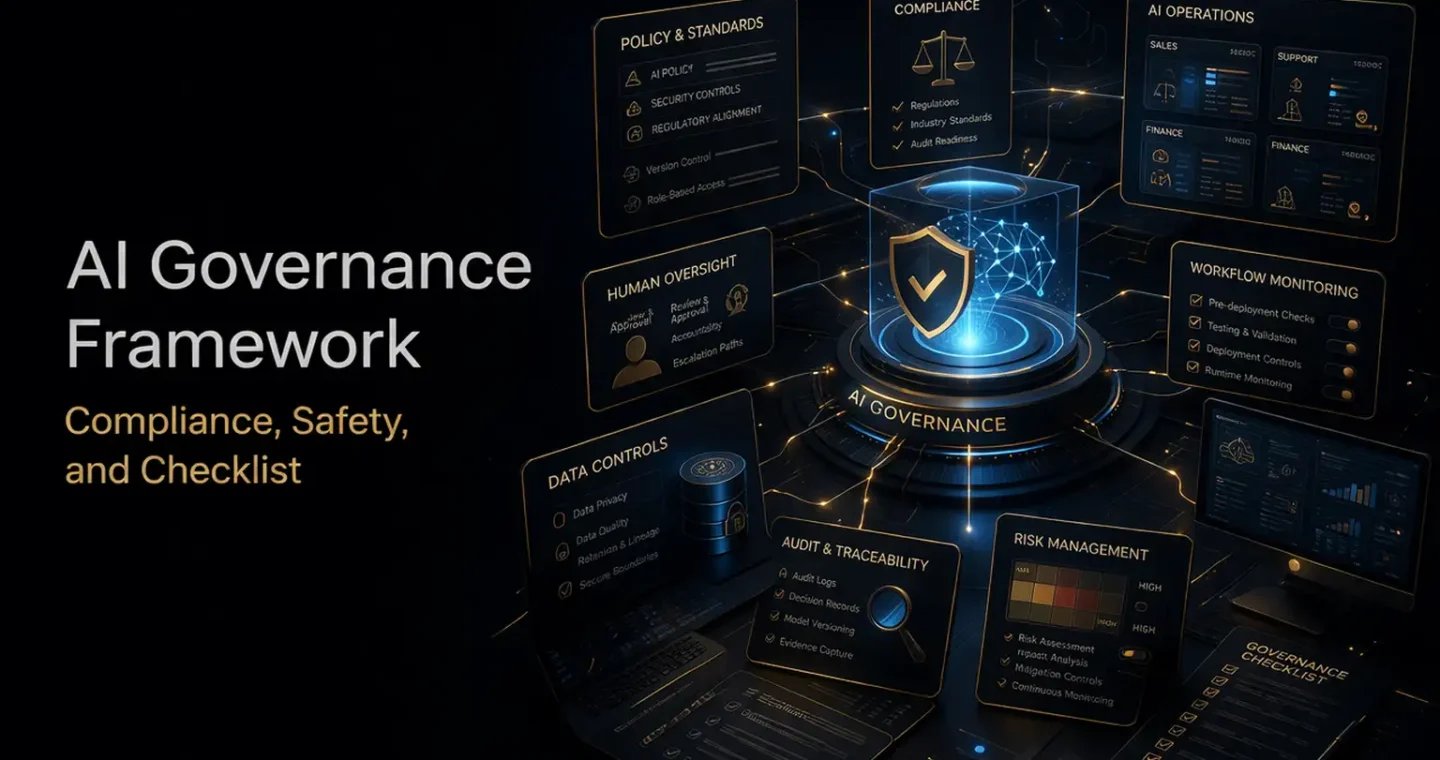
AI governance is the operating system behind responsible AI use.
Not the policy PDF.
Not the legal disclaimer.
Not the one-time approval meeting.
The real framework is the structure that decides how AI gets approved, where it can be used, what risks must be checked, who owns the outcome, and what happens when something goes wrong.
That is why AI governance has moved out of theory and into operations. NIST’s AI Risk Management Framework is built for organizations that design, develop, deploy, or use AI systems, and it is meant to help them manage risk while promoting trustworthy and responsible AI. ISO/IEC 42001 takes that a step further by defining requirements for an AI management system that can be established, implemented, maintained, and continually improved across an organization.
For business leaders, the implication is simple:
Once AI touches customer interactions, internal workflows, decisions, sensitive data, or regulated processes, governance is no longer optional. It becomes part of execution.
What an AI governance framework actually is
An AI governance framework is the structure an organization uses to control AI across its lifecycle.
That includes:
- decision rights
- risk review
- compliance controls
- human oversight
- data boundaries
- vendor management
- monitoring
- escalation
The strongest definition comes from combining two viewpoints.
NIST treats AI governance as part of risk management across the full lifecycle of AI systems. ISO/IEC 42001 treats it as a management system for responsible development, provision, or use of AI systems within an organization. Put together, that means governance is not only about reducing harm. It is also about making AI manageable at scale.
So in plain business language:
An AI governance framework is the system that keeps AI useful, controlled, auditable, and aligned with legal and operational reality.
Why enterprises need governance before they need more AI
Most organizations do not fail with AI because the model is too weak.
They fail because:
- teams adopt tools faster than controls
- sensitive data moves into systems with unclear boundaries
- no one owns the risk
- outputs are trusted without enough review
- use cases expand before governance catches up
That is exactly why the newer enterprise conversation is shifting away from “What model should we use?” and toward “What operating controls do we need?” NIST’s framework is intentionally use-case agnostic and voluntary so organizations of different sizes can apply it flexibly, while ISO/IEC 42001 provides a formal management-system structure for doing that in a repeatable way.
The bigger the company, the more this matters.
Because at enterprise scale, weak governance does not stay contained. It spreads across departments, vendors, workflows, and data environments.
The four pillars of a serious AI governance framework
A lot of articles turn AI governance into a vague list of principles. That is not enough.
In practice, an enterprise framework has four real pillars.
Control
The organization needs clear authority over who can approve, deploy, and monitor AI systems.
Without control, governance becomes suggestion instead of policy.
NIST’s Playbook puts this under the Govern function, which focuses on policies, processes, procedures, and practices being in place, transparent, and implemented effectively. It also calls out the need to understand, manage, and document legal and regulatory requirements involving AI.
Risk
Every meaningful AI use case creates a risk profile.
The question is not whether risk exists. It is whether the organization can identify, measure, prioritize, and respond to it.
NIST structures this through its Govern, Map, Measure, and Manage functions, and its Playbook makes clear that organizations should prioritize and respond to AI risks using documented approaches rather than informal judgment.
Compliance
AI is no longer just an innovation issue. It is also a regulatory issue.
The EU AI Act uses a risk-based model, and some obligations are already in force or phased into force. The Commission’s materials make clear that providers of general-purpose AI models face obligations such as technical documentation, a copyright policy, and a training-data summary, while Article 4 requires providers and deployers to ensure a sufficient level of AI literacy among relevant staff and operators.
Even outside the EU, the compliance lesson is obvious: governance must be able to prove what the company did, why it approved it, and how it manages ongoing risk.
Trust
If employees do not trust AI, adoption stalls. If they trust it too much, risk rises.
That is why trustworthy AI is central across major frameworks. NIST focuses on trustworthy and responsible AI, while the OECD AI Principles promote AI that is innovative and trustworthy and that respects human rights and democratic values.
In practice, trust comes from good controls, not slogans.
What belongs inside the framework
A useful AI governance framework is operational. It has moving parts.
Governance structure
Every AI program needs named ownership.
At minimum, that usually means:
- executive sponsor
- legal or compliance lead
- security lead
- technical owner
- business owner
ISO/IEC 42001 is especially useful here because it frames AI governance as a management system, which naturally requires defined responsibilities, processes, and continual improvement rather than ad hoc oversight.
Use-case classification
Not every AI use case deserves the same control level.
A meeting-summary assistant is not the same as a customer-facing pricing assistant. A content draft helper is not the same as an AI-enabled compliance workflow.
That is why governance needs tiering:
- low-risk internal productivity use
- medium-risk workflow assistance
- high-risk or regulated use
This matches the general logic of the EU AI Act, which is built on risk differentiation rather than one universal rule set.
Data governance
This is where many companies get exposed.
A framework should define:
- what data may be used with which systems
- what data is restricted
- what is prohibited
- retention expectations
- logging requirements
- access controls
The Commission’s AI literacy guidance also reinforces that governance is tied to context of use, staff capability, and the people affected by the system, not just the tool itself.
Vendor and model governance
Many enterprises rely on third-party AI vendors, model providers, copilots, or APIs.
That means governance must cover:
- vendor terms
- security posture
- documentation
- incident handling
- model limitations
- provider obligations where relevant
This is especially important under the EU AI Act’s distinction between different actors, including providers and deployers in certain contexts.
Human oversight
The best AI governance frameworks are honest about where AI should stop.
Human review should usually remain in place when outputs affect:
- legal interpretation
- financial decisions
- customer commitments
- employment actions
- regulated processes
- high-impact internal approvals
That is consistent with NIST’s trustworthiness focus and the broader policy direction toward accountable AI use.
Monitoring and response
Governance does not end at launch.
A production-ready framework should define:
- what gets monitored
- what counts as a failure
- who gets notified
- when a system is paused or rolled back
- how incidents are documented
- how reviews are repeated over time
ISO/IEC 42001 explicitly emphasizes continual improvement, which means monitoring is not optional. It is part of the management system itself.
Compliance is not the whole framework, but it changes the standard
A lot of organizations still treat AI governance as internal best practice.
That is no longer enough.
The EU AI Act has turned governance into a more formal discipline for many organizations that operate in Europe or serve EU markets. The Commission’s materials show that obligations already apply in areas such as general-purpose AI model requirements like LLMs and AI literacy, while additional obligations continue to phase in.
That means a governance framework should be able to answer questions like:
- what AI systems are we using
- who approved them
- what risk level do they carry
- what data do they touch
- what documentation exists
- what oversight is in place
- what training have relevant teams received
If leadership cannot answer those questions quickly, governance is probably weaker than it looks.
Safety in AI governance is broader than security
Security matters, but safety is wider.
An AI system can be secure and still be unsafe in practice.
For example:
- it may give misleading advice
- it may generate overconfident summaries
- it may create harmful operational shortcuts
- it may encourage false trust in weak outputs
- it may be placed into a workflow that lacks escalation
NIST’s frameworks are useful here because they treat AI risk in socio-technical terms, not just technical ones. The Generative AI Profile was released specifically to help organizations address the unique risks posed by generative AI while aligning governance with their own priorities and goals.
That makes safety a workflow question as much as a model question.
The enterprise checklist that actually matters
Here is the version that is useful in practice.
Governance and ownership
- assign executive sponsorship
- define legal, technical, security, and business owners
- create an approval path for new AI use cases
Use-case review
- classify by risk
- define intended purpose
- document acceptable use
- define human oversight requirements
Data controls
- identify approved and restricted data categories
- define retention and logging expectations
- restrict sensitive data where required
- review data flow across vendors and systems
Vendor and model controls
- review contracts and provider terms
- document model limitations
- check documentation and incident processes
- assess role-specific obligations where applicable
Risk management
- map operational, compliance, privacy, and reputational risk
- define thresholds for escalation
- document mitigation decisions
- review whether AI is appropriate for the task at all
That last point matters because NIST’s Playbook explicitly notes that AI may not be the right solution for every business problem, and organizations should weigh risks against benefits before proceeding.
Monitoring
- define ongoing review cadence
- monitor output failures and drift
- log incidents and corrective actions
- maintain an accessible documentation trail
Training and literacy
- train relevant staff
- define what users can and cannot do
- explain when outputs require verification
- adapt literacy requirements to role and context
The AI literacy requirement in the EU AI Act makes this especially timely.
What good AI governance looks like in the real world
Good governance does not feel heavy for the sake of being heavy.
It feels clear.
Teams know:
- what is allowed
- what requires approval
- what data can be used
- when human review is required
- who to escalate to
- how to document decisions
That clarity is what allows an organization to scale AI with less chaos.
The strongest governance frameworks do not try to stop AI adoption. They make adoption survivable.
That is the real point.
Because once AI moves from experimentation into real operations, the question is no longer whether the technology works. The question is whether the company can control how it works, where it works, and what happens when it fails.
That is exactly where an AI governance framework earns its value.
And for organizations building AI-enabled workflows, internal assistants, or operational systems, strong governance is not a blocker to speed. It is what makes speed sustainable.