Most B2B teams do not have an SEO strategy problem. They have a workflow problem.
The strategy is usually fine on paper: publish useful content, target the right topics, build authority over time, and turn organic traffic into pipeline. What breaks down is the messy middle. Research takes too long. Briefs are inconsistent. Drafts feel generic. Updates get delayed. Reporting becomes a monthly scramble. That is exactly why AI for SEO has become so attractive.
Used well, AI can remove a surprising amount of production drag. Used badly, it can flood your site with bland, repetitive pages that look “optimized” but do not actually help anyone. Google’s position is pretty clear on this: it focuses on the quality of content rather than how it was produced, but using automation primarily to manipulate rankings is against spam policy.
That is the real conversation B2B teams should be having. Not “Should we use AI for SEO?” but “Which parts of the workflow benefit from automation, and where does human QA still make or break results?”
AI for SEO Is Not the Same as Fully Automated Content
There is a big difference between AI-assisted SEO workflows and “publish 500 pages with one click” thinking.
AI-assisted workflows use automation to speed up research, drafting, classification, analysis, and repeatable production tasks. The human team still owns the judgment: choosing the angle, checking facts, refining the argument, adding original insight, and making sure the final page deserves to rank.
That distinction matters more now than it did a year ago. Google says high-quality content can be rewarded however it is produced, including with AI, but it also warns against scaled content abuse: large amounts of low-value or unoriginal pages generated mainly to manipulate rankings.
So the smart operating model is not “AI writes, humans publish.” It is closer to this:
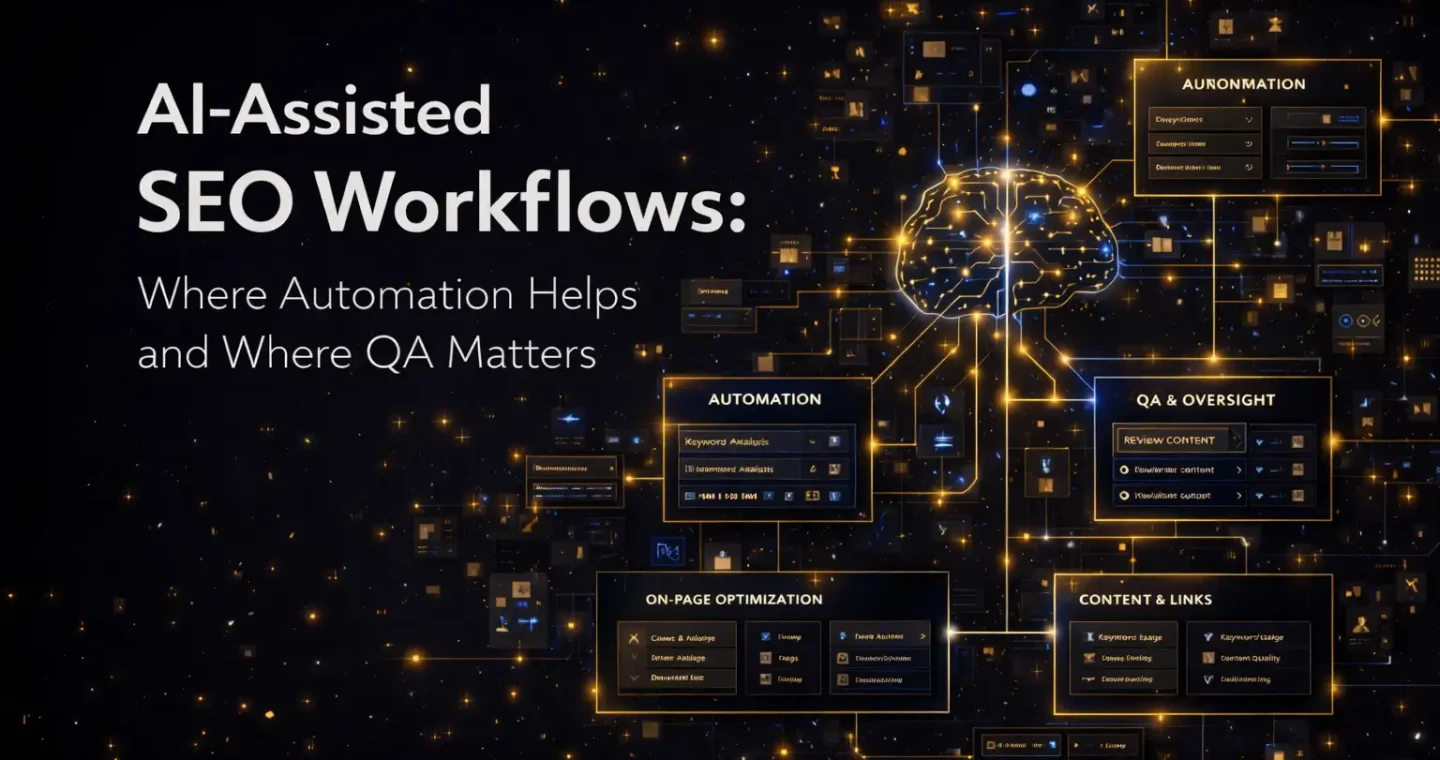
AI accelerates. Humans differentiate. QA protects the site.
That is the model that actually makes sense for B2B SEO teams.
Why This Matters More in AI Search
Search itself is changing. Google has said that in its AI search experiences, users are asking longer, more specific questions and then following up to dig deeper. Its advice to publishers is not to chase some new trick, but to create unique, non-commodity content that is genuinely useful and satisfying.
That changes the bar for content teams.
In a world of AI Overviews and more conversational search behavior, average content gets exposed faster. A generic post that says the same thing as ten other pages has less room to hide. If your article does not bring clarity, specificity, experience, or a distinct point of view, being “SEO-friendly” is not enough.
That is why AI can be both helpful and dangerous for SEO. It is fantastic at speeding up the average parts of the process. The problem is that average is exactly what you need to avoid.
Where AI Automation Actually Helps in SEO Workflows
This is where teams can get real value quickly.
1. Research Prep and Topic Mapping
One of the most useful applications of AI for SEO is turning messy research into something usable.
For example, say your team is building a content cluster around content SEO, technical SEO for SaaS, or B2B demand capture. AI can help:
- group keyword variations by intent
- surface recurring subtopics from SERPs
- turn raw notes into a cleaner topic map
- identify overlapping angles before they become cannibalization problems
- summarize competitor pages so strategists are not starting from a blank screen
This is a strong use case because it saves time without pretending the machine should decide the final strategy. AI helps you see the landscape faster. A strategist still decides what deserves its own page, what belongs inside a pillar, and what should be excluded.
That last part is important. Google’s people-first content guidance explicitly asks whether your site has a clear focus and whether readers leave feeling they learned enough to achieve their goal. That kind of scoping judgment is still human work.
2. Brief Creation and First-Draft Structure
This is probably where most teams feel the immediate productivity gain.
A solid AI-assisted workflow can turn a messy pile of SERP notes, keyword themes, product context, and audience information into a decent first brief in minutes. That means:
- suggested H2s and H3s
- likely questions to answer
- angle recommendations based on intent
- rough content gaps from current top-ranking pages
- draft metadata ideas
- possible internal link opportunities
Used this way, AI is not replacing the content strategist. It is giving them a faster first pass.
That is a huge difference.
A weak team publishes the raw output. A strong team uses the output to skip the blank-page phase, then sharpens the structure so it actually fits the audience and the site.
For B2B teams especially, that matters because search intent is rarely as simple as “define the term.” A page targeting decision-stage readers needs a different frame than one aimed at category education. AI can propose both. A strategist has to choose.
3. Content Refresh Workflows
AI is especially useful when you are not creating from scratch but improving what already exists.
Refreshing content is often less glamorous than launching new pages, but it is one of the most practical SEO workflows to automate. AI can help teams quickly:
- compare an old article to current SERP patterns
- flag outdated sections
- suggest missing questions
- find internal linking opportunities
- summarize what changed in the surrounding search landscape
- identify pages that need a clearer angle, not just a newer date
That last point is worth underlining. Google specifically warns against changing dates just to make pages seem fresh when the content has not substantially changed. It also says there is no preferred word count, which is useful because many content refreshes go wrong by adding fluff instead of making the page better.
Good refresh workflows are not about making the article longer. They are about making it sharper, more current, and more useful.
4. Metadata, Internal Linking, and Repetitive On-Page Tasks
This is not the most exciting part of SEO, but it is where a lot of time quietly disappears.
AI can be genuinely helpful for repetitive on-page tasks like:
- drafting title tag options
- writing meta description variations
- suggesting anchor text ideas
- identifying related pages for internal links
- generating schema draft text where appropriate
- standardizing FAQ formatting
These are ideal automation candidates because they are repeatable, lightweight, and easy to review quickly.
The key word is review.
A title can be technically fine and still be the wrong pitch. A meta description can be clear and still sound like every other result. Internal linking suggestions can be relevant on paper but awkward in the actual paragraph.
This is where AI works best as a strong assistant, not a final editor.
5. Performance Analysis and Reporting Support
Most SEO teams do not need AI to tell them whether traffic went up or down. They need help turning scattered data into a coherent narrative.
That is where automation can save serious time.
Google has recently expanded reporting options in Search Console, including a branded queries filter that helps eligible sites separate branded from non-branded traffic more clearly. For B2B teams, that is useful because it helps distinguish demand capture from organic discovery.
AI can sit on top of that kind of data and help with:
- summarizing weekly performance changes
- clustering page-level wins and losses
- spotting likely causes worth investigating
- drafting stakeholder updates in plain English
- highlighting non-branded growth opportunities
Again, this is a good AI task because it reduces analysis friction. But the actual interpretation still needs a person who understands the business, the content plan, and what the numbers do or do not mean.
Where QA Matters More Than People Think
This is where too many teams get lazy.
AI can speed up output. It cannot guarantee that the output is worth publishing.
1. Search Intent Judgment
Intent is not just a keyword label. It is about what the reader actually needs at that stage.
A term like “AI for SEO” could justify a beginner explainer, a tool comparison, a workflow guide, or a thought-leadership piece about where human oversight still matters. AI may generate all four. It takes a strategist to know which one belongs on your site, for that audience, in that content ecosystem.
When teams skip this step, they end up publishing content that looks complete but misses the real job of the page.
2. Originality and Point of View
This is probably the biggest reason raw AI content feels flat.
The structure is usually okay. The sentences are often clean. But the article sounds like it could belong to anyone.
Google’s guidance for AI search experiences is blunt here: focus on unique, valuable, non-commodity content. That applies to classic blue-link SEO too, not just AI results.
For B2B content, originality does not always mean original research. Sometimes it means:
- a sharper strategic framing
- a clearer decision model
- real examples from client work or in-house execution
- a better explanation of trade-offs
- stronger editorial judgment about what to leave out
AI can help produce content. It usually does not create distinction on its own.
3. Factual Accuracy and Source Integrity
This is the QA layer you skip at your own risk.
Any workflow that touches statistics, legal claims, product details, industry benchmarks, pricing, medical topics, compliance issues, or technical recommendations needs source checking. Not “skim the draft and vibe-check it.” Actual verification.
This matters even more in SEO because published errors do not just weaken trust with the reader. They weaken trust in the site.
If a page is built on shaky claims, no amount of optimization is going to turn it into durable content.
4. Brand Voice and Commercial Relevance
A lot of AI-generated SEO content is readable but commercially useless.
It may answer the query, but it does not connect naturally to the business, product, service model, or audience reality. That is a problem for B2B teams because ranking alone is not the end goal. The page needs to support pipeline, positioning, authority, or at least audience fit.
Human editors are usually the ones who make that jump well. They know how to move from “topic coverage” to “brand-relevant content that still feels useful.”
That is not a minor difference. It is often the difference between traffic and actual business value.
A Practical AI-Assisted SEO Workflow for B2B Teams
If you want a workflow that is fast without becoming sloppy, this is a sensible model:
Step 1: Human sets the scope
Choose the target keyword, search intent, business angle, topical boundary, and page role in the site structure.
Step 2: AI accelerates research
Use AI to cluster SERP notes, summarize competing pages, extract common subtopics, and draft a first-pass outline.
Step 3: Human sharpens the brief
Cut generic sections. Add the real angle. Define what the page should not cover. Insert product, audience, and internal-link context.
Step 4: AI supports the draft
Use it for section expansion, transitions, formatting help, title ideas, FAQs, and refresh suggestions.
Step 5: Human performs QA
Check facts, claims, links, intent fit, originality, tone, positioning, and whether the page actually says something useful.
Step 6: AI helps post-publish analysis
Summarize performance shifts, identify update candidates, and support content refresh prioritization.
This is the sweet spot: automation where repetition exists, human review where judgment matters.
The Rule That Keeps Teams Out of Trouble
A simple rule works surprisingly well:
If the task is repetitive, structured, and easy to review, automate more of it.
If the task affects trust, differentiation, or strategic fit, raise the QA bar.
That one filter will save your team from a lot of bad publishing decisions.
Final Thought
AI is not the enemy of SEO. Mediocre publishing habits are.
For B2B teams, the real opportunity is not to pump out more pages faster. It is to build a workflow that removes busywork without removing judgment. The teams that win with AI for SEO will not be the ones producing the most content. They will be the ones using automation to move faster on the parts that should be fast, while protecting the parts that still need a human brain, a human standard, and a human sense of what actually deserves to rank.
That is where automation helps.
That is where QA matters.
And that is the difference between scaling output and building a search asset.
FAQ
Is AI-generated content bad for SEO?
Not automatically. Google says it evaluates content based on quality, not whether a human or AI produced it. The risk comes when automation is used mainly to manipulate rankings or publish low-value pages at scale.
What parts of SEO are easiest to automate with AI?
Research prep, content briefs, metadata drafting, internal link suggestions, refresh analysis, and reporting support are usually the safest starting points because they are repeatable and relatively easy to review.
Where does human QA matter most in AI-assisted SEO workflows?
Search intent, factual accuracy, originality, source verification, brand fit, and strategic scope are the main areas where human review still matters most.
Can AI help with content refreshes?
Yes. It can quickly compare older pages to current SERP patterns, identify missing questions, and suggest structural improvements. But teams still need to decide what is worth updating and how to improve the page meaningfully.
Does Google prefer longer content?
No. Google explicitly says it does not have a preferred word count. A better page is not necessarily a longer page. What matters is whether the content is useful, satisfying, and focused on people rather than search engines.