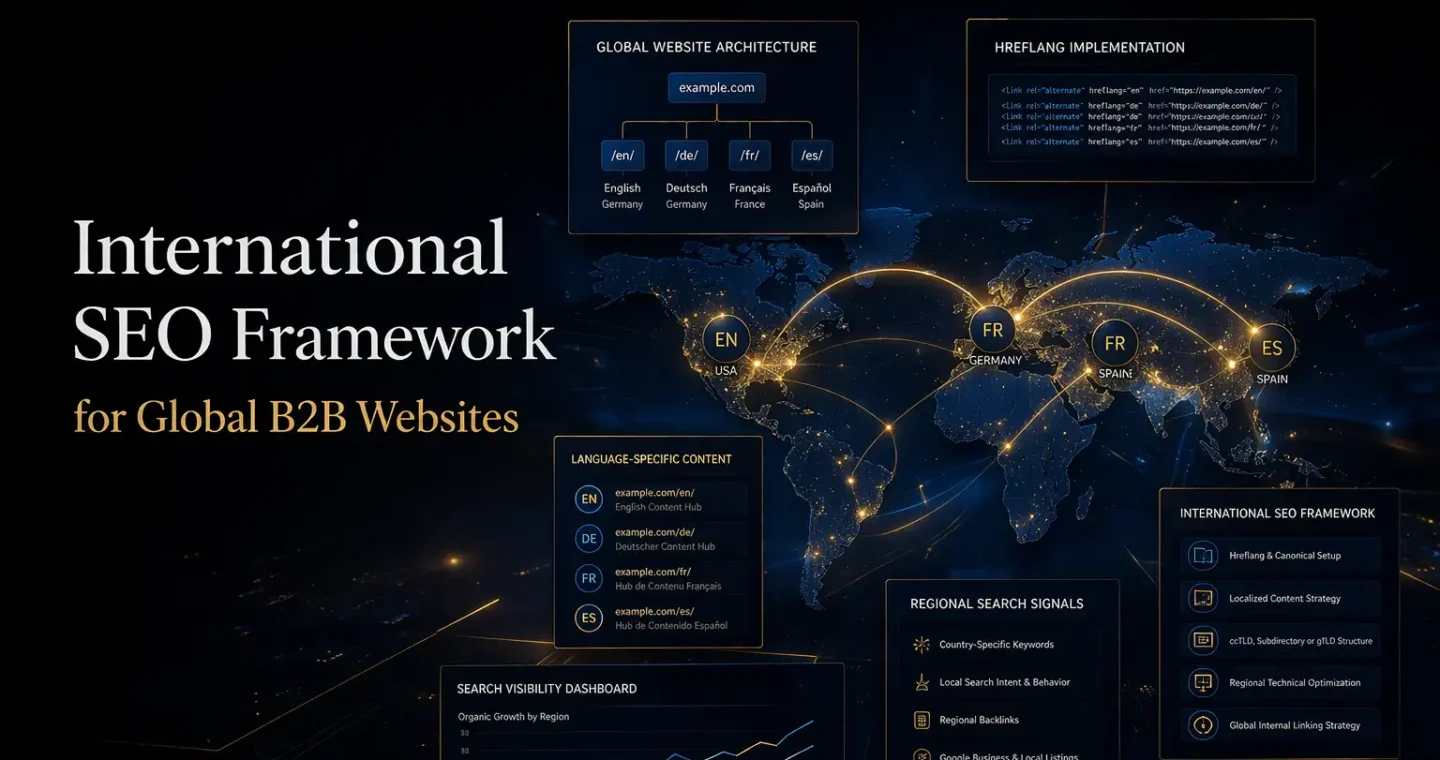
Most international SEO problems do not start with tags.
They start with assumptions.
A company expands into more markets, adds a few translated pages, creates a /uk/ folder or launches a second language version, and assumes the rest is mainly technical cleanup. Then the real issues show up. The wrong pages rank in the wrong countries. English pages compete against each other across regions. A translated page exists but never becomes the preferred result. Internal links point users to the wrong market version. And suddenly “global SEO” becomes a patchwork of fixes instead of a framework.
That happens because international SEO is not just a translation task.
It is a structure task.
Google’s guidance is very clear on this point: international sites may be multilingual, multi-regional, or both, and each setup needs deliberate signals so Google can understand which version is meant for which users. Google also recommends using separate URLs for different language or regional versions and using hreflang when you have localized alternatives.
For B2B websites, this matters even more. Global buyers often search in different languages, but they also search with different commercial expectations, local regulations, regional terminology, and market-specific service needs. So a strong international SEO framework has to do more than surface translated pages. It has to make the site structurally clear across markets.
- What international SEO actually means
- Why global B2B websites need a framework
- The first distinction: multilingual vs multi-regional
- The core mistake global websites make
- The international SEO framework for global B2B websites
- 1. Decide the market model before the URL model
- 2. Choose a URL structure that can scale cleanly
- 3. Make the language obvious on the page itself
- 4. Use hreflang correctly when pages are true alternatives
- 5. Localize meaningfully, not cosmetically
- 6. Keep canonical logic aligned with regional intent
- 7. Build internal linking that respects market versions
- 8. Avoid locale-adaptive traps unless you really need them
- 9. Decide what stays global and what becomes local
- 10. Measure by market, not only by total traffic
- What a strong international SEO setup looks like
- What international SEO is not
- Why this matters for global B2B growth
- FAQ
What international SEO actually means
International SEO is the process of helping search engines understand which version of your content should appear for users in different countries, languages, or market contexts.
That sounds simple, but it includes several different scenarios:
- one language, multiple regions
- multiple languages, one region
- multiple languages, multiple regions
- global English plus regional localization
- product or service content that changes by market
Google describes this distinction directly: some sites are multi-regional, meaning they explicitly target users in different countries, while others are multilingual, meaning their content is available in different languages. A site can also be both.
That is the first key point.
International SEO is not one setup. It is a choice between setups.
Why global B2B websites need a framework
A B2B site expanding internationally usually has more complexity than a consumer brochure site.
The company may need to reflect:
- different service availability by market
- region-specific compliance or legal context
- different buyer terminology
- different pricing or sales processes
- local case studies
- language-specific content expectations
- different lead routes or contact paths
That means the SEO problem is not only “Which page ranks?”
It is also:
- Which page should own this market?
- Which page is too generic for local intent?
- Which pages should stay global?
- Which pages deserve regional versions?
- How do we prevent duplication while still localizing meaningfully?
Google’s SEO Starter Guide keeps pointing back to useful organization and clarity, which is exactly what international SEO needs at scale. A global site that is messy in structure is harder for both users and search engines to understand.
The first distinction: multilingual vs multi-regional
This is the first place many companies get confused.
Multilingual SEO
This is when content exists in different languages.
Examples:
- English
- German
- French
- Indonesian
The goal is to match language preference.
Multi-regional SEO
This is when content targets users in different countries or regions, even if the language is the same.
Examples:
- English for the United States
- English for the United Kingdom
- English for Singapore
The goal is to match market context.
Google treats these as different concerns. A site may have content in the same language for different regions, or different languages for the same region, or both at once.
That matters because the architecture should follow the actual business need, not a generic global template.
The core mistake global websites make
A lot of international sites create local versions before deciding whether the page really deserves localization.
That leads to weak patterns like:
- duplicate English pages for multiple markets with barely any difference
- translated pages that keep the same generic commercial copy
- country pages created only to target a location keyword
- pages with local folders but no real local value
- partial translations that confuse both users and crawlers
Google’s guidance warns against showing different language or regional versions dynamically based only on user location or browser settings if that makes it harder for Google to crawl all versions. It specifically says locale-adaptive pages are harder for Google to crawl and recommends separate URLs for different language versions.
So the framework should begin with one question:
Does this market need a distinct page, or just access to a different language version?
That is how you avoid artificial page multiplication.
The international SEO framework for global B2B websites
The cleanest way to think about international SEO is in layers.
1. Decide the market model before the URL model
Do not start by picking folders, subdomains, or ccTLDs.
Start by defining how the business actually goes to market.
For each country or region, ask:
- Are we targeting this market separately?
- Is the language different?
- Is the offer different?
- Is the regulatory context different?
- Is the commercial intent meaningfully different?
- Would users expect localized content or just translated access?
Google’s documentation supports this “intent first” approach because it distinguishes between language targeting and regional targeting before it gets into implementation details.
That means your architecture should be driven by market reality, not by CMS convenience.
2. Choose a URL structure that can scale cleanly
Once the market model is clear, pick a URL structure that matches it.
Google says separate URLs are recommended for different language versions because they help Google discover and crawl them more effectively. Typical options include:
- country-code top-level domains
- subdomains
- subdirectories with country or language indicators
- URL parameters, though those are generally the least clean option structurally
For most B2B sites, the strongest options are usually:
- subdirectories for language or country versions
- subdomains when there are operational reasons for separation
- ccTLDs only when the business has strong local-country reasons to justify the overhead
The point is not that one format always wins. The point is that the structure should stay consistent and readable.
3. Make the language obvious on the page itself
Google says it does not use the lang attribute or hreflang to detect the language of a page. Instead, it determines language from the visible content itself. That is one of the most important facts in international SEO because it means a translated template with minimal translated body content can still create weak signals.
So in practice:
- the main body content must clearly be in the target language
- navigation and support elements should not overwhelm the language signal
- mixed-language pages should be handled carefully
- partial translation should not be treated as finished localization
This is why global SEO fails when teams think changing the menu and headline is enough.
4. Use hreflang correctly when pages are true alternatives
hreflang is one of the most discussed parts of international SEO, but the principle is simple.
Google says hreflang is used to tell Google about localized versions of your pages so it can serve the right version to the right users. It can be implemented in HTML, HTTP headers, or XML sitemaps. Google also notes that all versions should reference each other and that return links matter.
That means hreflang works best when:
- the pages are actual localized alternatives
- each version has its own stable URL
- the reciprocal relationships are in place
- the language and regional targeting are accurate
- the cluster includes an
x-defaultwhere appropriate
What hreflang does not do is fix weak localization or make low-value duplicates suddenly useful.
5. Localize meaningfully, not cosmetically
This is where many B2B sites underperform.
They translate text, but they do not localize the page.
A strong international page may need differences in:
- examples
- terminology
- trust signals
- legal language
- market references
- CTA expectations
- service scope
- local proof points
Google’s guidance on multi-regional and multilingual sites points out that just translating a small amount of content may not be enough to differentiate pages meaningfully. It also recommends making the language and targeting clear to users.
For B2B companies, that means international SEO is often closer to market adaptation than literal translation.
6. Keep canonical logic aligned with regional intent
International SEO gets messy fast when canonical signals fight regional logic.
If localized alternatives exist for different audiences, they usually should not all canonicalize to one global page unless they are truly duplicates that should not exist separately.
Google’s documentation explains that hreflang and canonicalization serve different purposes. Canonical tags help consolidate duplicate URLs, while hreflang tells Google about alternate localized versions. Mixing those up can cause the wrong page to dominate.
A good rule is:
- if the page deserves to exist for a distinct locale or language, let it stand as its own canonical
- if it does not deserve to exist separately, do not create it just to capture a market variant
That avoids a lot of international SEO confusion.
7. Build internal linking that respects market versions
A global site should not force users and crawlers to guess which version belongs where.
Google’s SEO Starter Guide emphasizes logical organization and helpful linking structure. In an international setup, that means:
- local pages should link to the right local versions
- navigation should make switching versions understandable
- breadcrumbs and internal links should reinforce the current market context
- the wrong region should not dominate internal pathways by accident
This is especially important for B2B service sites, where one region’s service page should not constantly funnel authority to another region’s version unless that is the intended primary market.
8. Avoid locale-adaptive traps unless you really need them
Some sites show different content based on user IP, browser language, or geolocation.
Google specifically says locale-adaptive pages can be harder for it to crawl because Googlebot may not see all versions of the content. It recommends separate URLs when possible.
For most B2B sites, this means:
- avoid making the primary content dependent on geolocation
- do not hide alternate versions behind forced redirects
- let users and crawlers access all market versions directly
- use banners or selectors instead of automatic lock-in when possible
This is one of the most practical international SEO fixes there is.
9. Decide what stays global and what becomes local
Not every page needs to be localized.
This is one of the most important strategic decisions in the framework.
Usually, a global B2B site has three kinds of content:
- pages that should stay global
- pages that should be translated
- pages that should be regionally rebuilt
Examples:
- a general thought-leadership article may stay global
- a product explainer may need translated language versions
- a service page may need regional adaptation if the commercial offer, compliance context, or buyer language really differs
This is where international SEO becomes a business decision, not just an SEO task.
10. Measure by market, not only by total traffic
A global SEO program can look healthy in aggregate while failing in specific countries or language groups.
That is why the framework should track:
- impressions by country
- clicks by country
- performance by language section
- page ownership by market
- indexation of localized sections
- hreflang implementation issues
- conversions by market where possible
Google’s Search Console is still the core measurement environment here, especially when the site is segmented clearly enough to analyze sections and regional performance with real clarity.
What a strong international SEO setup looks like
A strong setup usually feels less dramatic than people expect.
It does not try to create every market page possible.
Instead, it does these things well:
- the URL architecture is predictable
- the language is obvious on each page
- localized alternatives are clearly mapped
- internal linking respects the market structure
- localization is meaningful where it exists
- the site is still understandable as one coherent system
That is what makes international SEO sustainable.
Not “more country pages.”
Not “more folders.”
But better alignment between market reality and site structure.
What international SEO is not
It is not just hreflang.
It is not just translation.
It is not just country folders.
It is not creating dozens of near-duplicate local pages with the same pitch.
And it is definitely not a technical patch you add after the global site architecture is already messy.
Google’s documentation on international and multilingual sites keeps reinforcing this broader point: signals only work well when the underlying site structure makes sense.
Why this matters for global B2B growth
International SEO matters because global visibility is not just a traffic problem. It is a market-fit problem.
When the wrong page ranks in the wrong country, trust weakens.
When a translated page feels generic, conversion weakens.
When the structure is unclear, both users and search engines lose confidence.
A strong international SEO framework solves that by making the global site easier to understand at every level:
- language
- market
- service intent
- structure
- user pathway
That is what makes it valuable for B2B brands.
Because a global website should not just reach more countries.
It should make the brand feel locally legible without becoming globally fragmented.
That is the real framework worth building.
If your team is planning international expansion or cleaning up a global site that has outgrown its structure, our SEO Marketing services are built to help create that kind of international clarity.
FAQ
What is international SEO?
International SEO is the process of helping search engines understand which version of your content should appear for users in different countries, regions, or languages. Google distinguishes between multilingual sites, multi-regional sites, and sites that are both.
What is the difference between multilingual and multi-regional SEO?
Multilingual SEO focuses on serving content in different languages. Multi-regional SEO focuses on targeting users in different countries or regions, even if the language is the same. Google treats these as separate but related concerns.
Does Google use hreflang to detect page language?
No. Google says it does not use hreflang or the HTML lang attribute to detect the language of a page. It determines language from the visible content itself. hreflang is used to understand localized alternatives.
Should international sites use separate URLs for each language or region?
Usually yes. Google recommends using separate URLs for different language or regional versions because it helps with crawling and discovery, especially compared with locale-adaptive setups.
Are translated pages enough for international SEO?
Not always. Translated pages can support multilingual SEO, but some markets need deeper localization around terminology, trust signals, commercial context, and user expectations. This is an inference based on Google’s distinction between multilingual and multi-regional targeting and its recommendation for clear user-oriented localization.